Wednesday, 12 October 2016

Fjaerlands: Exciting Tuesday


A days climbing Fjaerland proved to be one of the more exciting Tuesdays of my life. I found a blog entry describing relatively straightforward days climbing: 


Google translate struggles with this one, key information simply doesn't make scene. But without thinking too much about it myself and Peter (one of the only climbers in Belgium) decided that the library could wait for a rainy day and took a short drive though lots of tunnels to Fjaerland.

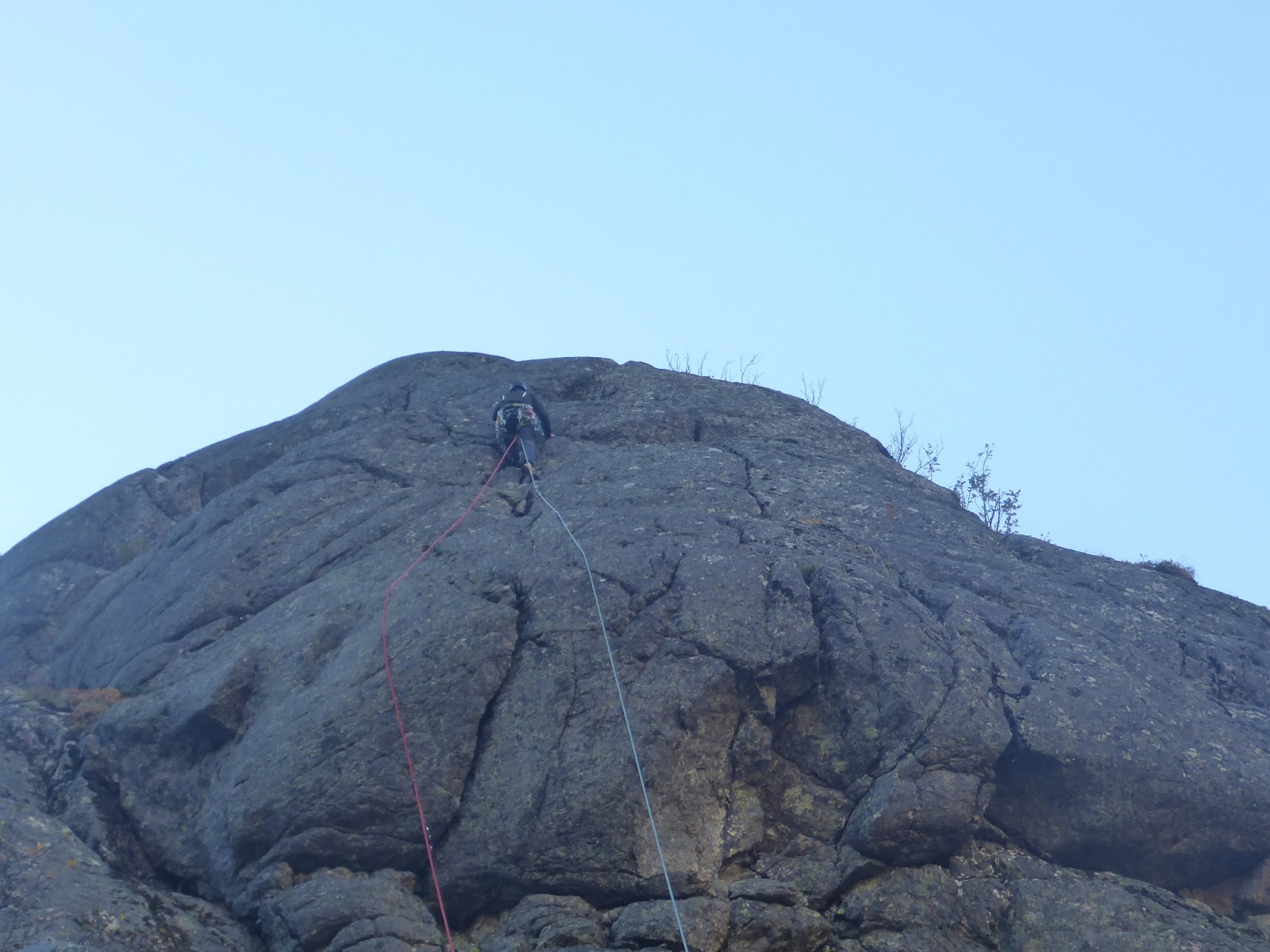
Me starting up the fantastic 1st pitch. 


Pieter on the second.


The third pitch was too scary for photos, 30m of slab padding with out any gear.... I think we were off route.

On the 5th pitch we decided to keep on going upwards, it seemed like the natural line and the climbing was good quality. 


 We ended up climbing the rising spurs and broken scrambling terrain for a further 700m! a mixture of glorious, (probably never climbed before,) super high friction crack lines and wet, chosy, louse , dangerous, shitty ground- proper adventure climbing! We raced up the last few hundred meters, moving together for most of the way and reached the 1290m top just as darkness fell. walking around the foot of the glacier in my rock shoes I felt distinctly under-prepared, the scale of the Norweigian mountains was defiantly settling in. I was relived and humbled to find a gift of a decent route to the south east, the only weakness in the cliff lines largly free from ice and snow.


9.30pm back at the car.

October Trad Climbing Adventures

High pressure over Norway. Its getting realy cold at night now but the sun warms up southern aspects nicly for rock climbing adventures!

One of the lecturers at the University told me about a lesser known mountain crag in the Ustadal valley. Myself Calum and two of Calum's strange french PHD student friends took potentially the last opportunity to go rock climbing in the mountains.

We walked up to a small cabin arriving just before darkness on Friday evening.


I LOVE NORWEGIAN CABINS! what a fantastic resource for anyone looking to spend as much time as possible in the mountains.

In the morning we looked for the crag. The temperature difference from the shaded areas to the sunny aspects was very stark.


We picked our sunny spot and went for it.


The climbing reminded me a lot of the Cairngorms, similar mixture of slabs and corner cracks left over from the last glacial period. In the background we could hear the glaciers cracking.

Voss

When most kayaker's think of the ultimate destination for world class white water two towns come to mind, Pucon Chile and Voss Norway. The latter certainly lived up to its reputation providing two of the best days kayaking I have ever had.

Three of us made the 3 hour journey from Sogndal. Since I was the tourist we took the scenic route across the fjord to Vangsnes then over the mountains.


The Myrkdalen is a steep low volume run that runs parallel to Voss's ski resort. Levels were low, perfect for a first run down the impressive cascades. We met up with two of the Local raft guides, Martin seemed to know every line intimately and I was glad to be in a team with so much local knowledge.

Martin on the first drop. I got this one wrong, missing the critical boof stroke and spending some time rolling around in the stopper at the bottom- not the start I was hoping for but i soon warmed up and my paddeling improved.


Technical drops followed after technical drops. This ones known as the  "Triple drop combo."

The first rapid that realy scared me was a long broken slide into a powerfull stopper, A technical entry followed by lots of kickers meant potential for a painful capsize then valiant, involintory surfing experience in the hole. I watched the others run this one first, with varying degrees of success (Jonas Backwards!)  Then it was my turn....


Just about made it through the hole at the bottom after a short surf at the bottom.

We continued on down more slides and drops, some the best rapids I have ever paddled. Most just about runable with out inspecting first, purely on the descriptions of the locals.  One member able slide was like going down a huge spiralling stair case.

After a arduous mandatory portage, I found myself in a walled in canyon looking at a very significant horizon line. There was no choice but to run it. I chose the left line- a smother transition on the upper section, so smooth infact I found myself flying into the next drop further left that I anticipated. 


I was pretty proud of my line on this one and it felt very good to be at the bottom.


The happy international team at the take out!
left to right. Matt (Aus), Jonas (Nor), Me and Martin (Nor)


As it was a Sunday (annoying everything in Norway closes on a Sunday) we got dinner out of the bins outside the super market, 3 of us slept in the van in a quiet part of town and woke up feeling refreshed and reinvigorated for another days hard kayaking (NOT)


The Raundalselva is a classic river of the Voss region. I was amazed how many of the rapids and waterfalls I recognised from watching kayaking videos as a teenager just starting out. The river can, apparently, be paddled from the end of the road all the way to Voss. The top section contains an infamous fall called 'Nosebreaker' and "the tunnel rapid" and is generally pretty bloody serious. The section we ran from Skiple to Urdland is a little easier and certainly less serious. The river is compressed into a long pushy gorge section, with a feeling of commitment and remoteness that certainly made me pay attention. The local knowledge of the guys I was following certainly made this an attainable yet challenging undertaking for myself. I paddled more white water that day than I have done in years in Scotalnd as an active kayker.


The few photos I got were of the portages. I think they portray the general feeling of the river well.

After many Kilometres of class 4. I could feel the exostion started to kick in, narrowly missing the ride of my life in the "buddy hole." At the top I could see the river disappearing from veiw in to a narrow canyon, sprey erupting from it. I asked martin the line who chuckled and said "the line is kind of fucked up- stat right, to centre to right again and boof the big hole on the right" After mistaking one of the earlier holes as being the big hole, (i guess big hole is all relative) I ended up dead centre on the lip of the really big hole, desperately took a rushed boof stoke of the lip, got tail squirted in the tow back which turned me 180 degrees to face the walled- in  hydrolic. luckily I was just on the boundary of the tow back and just got away with back paddling escaping a horrible kicking. LUCKY ME!

At the bottom my excited new friends high fived and told me we were just over half way.........

By the time we got to the last rapids there was ice forming on the rocks. I portaged one of the rapids and got some photos of the others.


Possibly the most memorable weekend of all time.


Thursday, 29 September 2016

Sjoa- Autumn is comming....


I joined the local kayaking club on their Weekend trip to Sjoa. Despite the low levels the "play section" is one of the best intermediate river trips I have ever done; beautiful surroundings and just the right amount of respite in between quality grade 3 rapids.


A few us us stayed on to run the infomas Amot section, the entire river is Squeezed into a steep sided gorge. Exceptional kayaking!


A very Humorous video of the trip https://vimeo.com/189424849

Tuesday, 27 September 2016

Jostrela


About an hour and a half north of Sogndal is yet another one of the best rivers I have ever paddled. I Whent with the local kayaking addicted Helge and Jonnas who once again showed me the lines and took me down rapids like this with out much introduction....

Me.....


School laps.

My quieter week around Sogndal, quickly turned into some kayking adventure.

The proximity of great white water to the Library is pretty ridiculous.....


So far this week iv run the lower Sogdal 3 times. Its super fun low volume creeking at grade 4. Im realy lucky to be boating with the locals, they know the section so well that they can just tell me the lines at the top of each horizon. Its super cool to kayak down a technical section so quickly purely on the very good descriptions of the local guys. 


In the evening light this is a relay beautiful place to hang out after classes. 


Blue Ice: Teaching Independent Glacier Travel

I hadn't spent much time on blue glacier ice before. This blog is written from the perspective of a climber, interested in teaching mountaineering techniques in inspiring settings; the outlet glaciers of the Jostesbren National park certainly provided.


The approach each morning from Jostesdal was short enough to get the group warmed up and socialising.  The first  glacier we visited was Nigersbreen, very popular with tourist groups and first time glacier travellers  due to its accessibility and low angled entry slopes.


The group were given almost an hour to rope up, A style of teaching adopted here that im gradually getting use to, the logic being its better to let the the group sort out their own systems with a little reminder of last nights practice than simply tying them in a heading off.


A brief introduction to walking in crampons was then provided. the group were instructed to walk slightly duck-footed, with our feet apart and roiling the ankles to allow all of the crampon points to engage with the hard ice.  I was then rather shocked to see the rate of task progression, our guide then led the rope together team on rapidly increasingly challenging terrain combinating in some very cool crevasse bridging.


Once on to the glacier the view is pretty staggering


 The group tentatively learning to trust their sharp points.


The last teaching part of our very interactive first day on the ice was ice screw placement, not so surprisingly straight forward when you are surrounded by quality ice. no questions were raised as to the quality of placements,- a new feeling for a Scotsman!


Day 2 and 3 focused primarily on Crevasse rescue. Certainly a doubting task when being confronted by carbines, prussiks and large crevasses for the first time. Suddenly the carefree practice attempt using trees at the campsite felt like a distant memory for most of the group.


The method of rescue Vegard and the other guides imparted to the international group was one of the most simplified I had seen. The person on the rope system nearest to the fallen casualty, places one 22 cm ice screw and transfers the load onto the anchor using the original prussik that was previously a part of their glacier walking system. An independent rescue rope was then utilised, gravity takes a locking carabiner to the casualty who then clips it in to their belay loop, and is instructed to keep themselves safe using there own prussik on the original glacier travelling rope. the whole rope team can then get involved and extract the casualty from  the crevasse.


An option to try ice climbing was presented to the group on the final day. Most of the students gladly took up the opportunity and we were shown to a steeper bowl like feature on the upper part of the Glacier, ideal for setting up top ropes and having a go at swinging climbing axes.


"remember guys hips in shoulders back its that easy." sound advise!

Comments and Reflections.

The visually striking and easily accessible nature of the Negaersbreen glacier in particular makes theses blue ice environments ideal teaching terrain. learning journeys an be condensed into short tours where newly acquired skills can be immediately tried out in a progressive and easily manipulated manor. I was honestly very impressed with the fulfilment of am ambitious list of technical  learning outcomes for everyone in the group. What an environment for introducing people to the joys of  Alpine mountaineering.

I liked how teaching focused almost entirely on developing footwork using crampons: It was good to see the teachers confidence in developing this before getting the group to think about using their axes. This is something I would like to take forward myself when working with beginners using crampons, focusing the groups attention on preventing a slide rather than guarding against one or by adding extra complications.

Teaching style was very rapid, for instance demonstrating an entire crevasse rescue scenario instead of introducing elements bit by bit such as explaining friction knots or the principles behind setting up a mechanical advantage. This worked for our group, however I don't think it would for most.

The rescue technique shown using a independent rescue rope does have some crucial limiting aspects that were not mentioned. The casualty would have to be conscious in order to attach the rescue rope to themselves, I felt that this was a point probably worth mentioning, as it wouldn't take long to expand the groups knowledge and use a secondary prussik to implant a Z rig system. 

I would have liked to talk a bit more about different rope teams. Moving on a rope as a large group of 6 is obviously different than moving in smaller teams, smaller teams travel more efficiently through technical terrain and can quickly chage to climbing mode. But a team of more than two has greater stopping power during a crevasse fall.(Davis, S, 2014, )something probably worth mentioning as the participants are likely to be venturing off in smaller groups next time.

All in all another incredible week of seeing how the mentors at HISF impart a wealth of knowledge to the class of international students. My eyes have defiantly been opened to the possibilities of teaching on the blue ice.

References

Davis, S, 2014, " Travelling on a Rope Team" Online at: http://www.climbing.com/skills/traveling-on-a-rope-team/